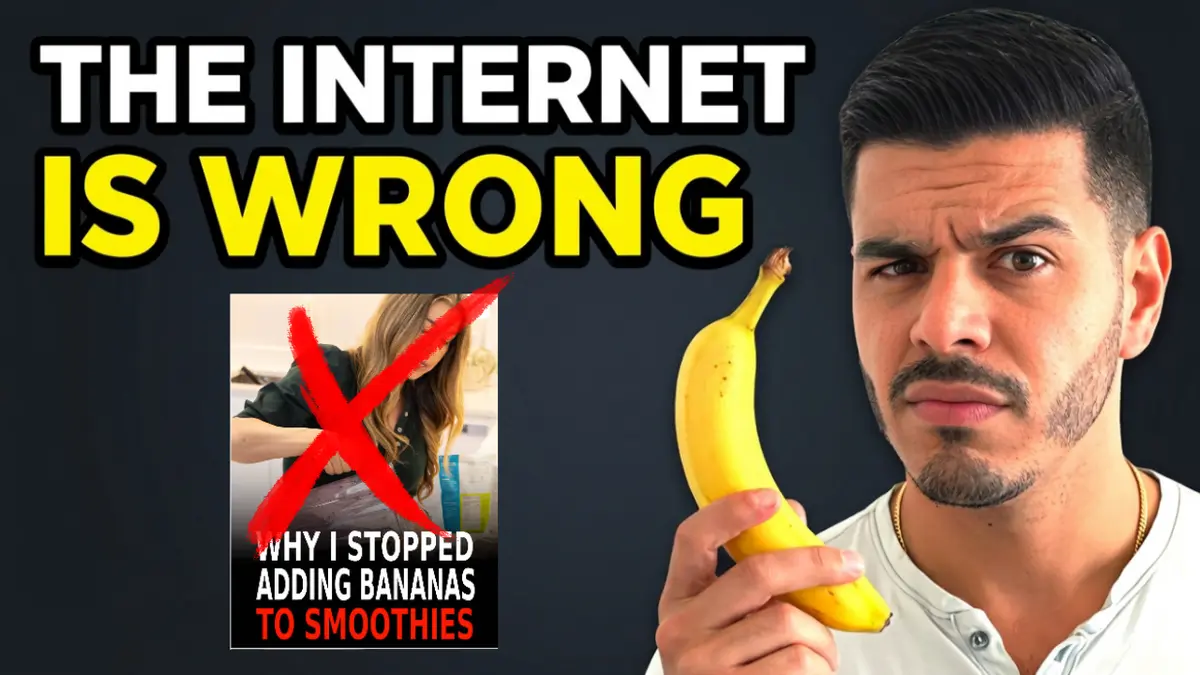
A Viral Clip Is Telling You to Stop Eating Bananas With Blueberries. Let's Look at the Actual Study.
There's a clip circulating right now with millions of views telling you to pull bananas out of your smoothies. It features Mel Robbins and Dr. Rhonda Patrick. It references a real study. And the way most people are walking away from it, they're getting exactly the wrong lesson.
The headline is engineered to scare. The science, when you actually read it, tells a much narrower story than the clip suggests. As a registered dietitian who reads this kind of research professionally, here's what the study actually shows, what it doesn't, and why the banana in your morning smoothie is probably fine.
What the Clip Actually Claims
The argument is this. Bananas contain a high level of an enzyme called polyphenol oxidase. That enzyme degrades polyphenols, specifically flavanols, the beneficial compounds found in blueberries. So when you blend a banana into a blueberry smoothie, the banana's enzyme breaks down the very nutrients you were trying to get from the blueberries.
The solution offered in the clip: swap the banana for avocado to preserve the creamy texture while keeping the blueberry flavanols intact.
The study being referenced is real. It was published in Food and Function in 2023 by Ottaviani and colleagues. The mechanism described is real. Polyphenol oxidase is the same enzyme that turns a sliced apple brown. Banana does have extremely high levels of it, around 3,258 units compared to 570 in an apple and just 12 in a blueberry. And yes, the study found that adding a banana dropped peak blood flavanol levels by approximately 84%.
That number is striking. It's also missing most of the context that determines whether it should change anything about how you eat.
What the Study Actually Measured
Here's what the clip doesn't tell you about how that study was designed.
The researchers did not blend a handful of blueberries into a smoothie and measure what happened to the flavanols in them. They used a standardized, isolated dose of a single flavanol compound called epicatechin, not the complex mixture of polyphenols naturally present in real blueberries. They then measured the absorption of that one compound in the presence of a banana.
The study involved 6 to 11 participants, all men, testing one isolated compound under controlled lab conditions.
What that study proves: a banana's polyphenol oxidase enzyme can degrade that one specific compound under those specific conditions. What that study does not prove: that blending a banana into your morning smoothie destroys the nutritional value of the blueberries in it. Those are two different claims. The viral clip presents only one of them.
The study's own lead author went on record after the clip went viral to say that bananas remain a great food to eat, even in smoothies. The person who ran the research said the headline misrepresented what the findings actually showed.
What You Actually Lose, and What You Keep
Even if you accept the study's findings at face value, the trade-off deserves a closer look.
When you add a banana to a blueberry smoothie, you potentially reduce the absorption of one class of flavanol compound. In exchange, you get: fiber, potassium, roughly 20% of your daily B6, about 17% of your vitamin C, magnesium, and real carbohydrates to fuel activity. The banana itself brings significant nutritional value that was never part of the study's analysis.
The question "is the banana destroying the nutrients in my smoothie?" frames a complicated trade-off as a binary. It isn't one. You're trading some absorption of one compound for a meaningful package of other nutrients, plus the texture and taste that make someone actually drink the thing every morning.
The Flavanol Argument Doesn't Hold Up on Its Own Terms
Here's the part of this conversation that gets ignored entirely. If maximizing flavanol intake is genuinely your goal, a banana-blueberry smoothie was never the most efficient way to get there.
Two small cups of green tea or about 12 ounces of black tea delivers a full 400 milligrams of flavan-3-ols, which is a category of flavanols, easily and consistently. That's more than the average blueberry smoothie was ever going to provide, banana or no banana.
People rearranging their entire breakfast routine to protect a modest amount of a compound they could get from a tea bag are optimizing the wrong variable. This is a pattern that runs through a lot of wellness content: chase a single metric from a lab study while ignoring the bigger picture of what actually makes a diet work.
On Rhonda Patrick and Mel Robbins
Credit where it's due: Rhonda Patrick holds a PhD in biomedical science with a background in aging and nutrition research. Her work on saunas and longevity is genuinely useful. The mechanism she describes in this clip is scientifically accurate.
But accurate mechanisms pulled from narrow studies and packaged as lifestyle directives for millions of people is where things go wrong. When she later clarified publicly that bananas are still a great food and that people can continue eating them, that correction barely traveled. The headline did. That's how viral health content works. The scare gets shared. The nuance stays in the comments.
Mel Robbins has a massive, loyal audience and genuine communication talent. When that platform hands the microphone to a claim that sounds scientific, it spreads fast and lands hard, even when the underlying study tells a more complicated story than the 50-second clip suggests.
Neither of them is acting in bad faith here. But the downstream effect of this content is real. Parents are pulling banana-blueberry smoothies from their kids' breakfasts over a flavanol concern that the study's own author said shouldn't change their behavior.
So Should You Stop Putting Bananas in Your Smoothie?
Stop asking whether a banana is good or bad. Ask a better question: what is this smoothie for?
If your specific goal on a specific morning is to maximize flavanol absorption, and you're building a smoothie intentionally around that, then yes, the research suggests keeping the banana separate or swapping it out. Eat it as a snack an hour later. Or just drink green tea and get more flavanols than the smoothie was ever going to give you anyway.
But if your goal is a nutritious, filling breakfast that a busy person or a kid will actually want to drink again tomorrow, keep the banana. Keep the blueberries. You're getting fiber, potassium, vitamins, and a meal that reliably gets consumed. The best nutrition plan is the one that actually gets followed.
Both answers are correct. They're just answers to two different questions. Match the tool to the goal instead of following the headline.
The Broader Pattern Worth Recognizing
This clip is not an isolated case. It's a template.
A narrow finding from a small study gets extracted from its context, compressed into a scary headline, distributed through a massive platform, and received by millions of people as a simple behavioral directive. Stop doing the thing. The thing is ruining your health.
The people sharing this content aren't always wrong about the science. They're often wrong about what the science means for normal people eating real food in real life. A specific finding about flavanol absorption in 6 to 11 men under controlled conditions does not translate directly into "don't put bananas in smoothies" as a general health recommendation.
Understanding the difference between what a study measured and what it means for your life is the actual skill. Not memorizing the headline. Not swapping every ingredient based on the latest clip. Reading the study, understanding the design, and asking who it applies to and under what conditions.
That's what changes outcomes. Not fear dressed up as optimization.
The Bottom Line
The study is real. The enzyme is real. The 84% reduction in flavanol absorption is real. None of that means what the viral headline told you it means.
Bananas are a nutritious food. Blueberries are a nutritious food. A smoothie containing both of them is a genuinely good breakfast option for most people, with or without some reduction in one class of flavanol compound. The study's own author said so.
If flavanols matter to you, drink green tea. If your smoothie matters to you, keep the banana.
Don't let a 50-second clip talk you out of feeding yourself or your family a genuinely good food.