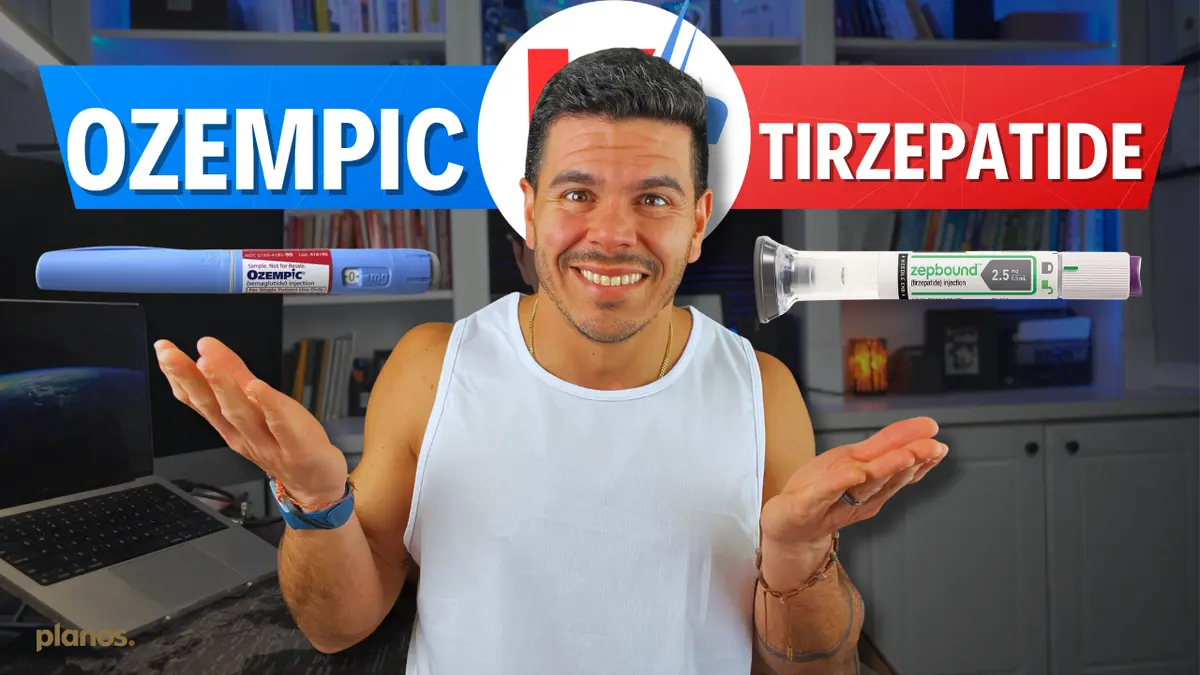
Tirzepatide Is Outselling Ozempic 3 to 1. That Doesn't Mean It's Right for You.
Over 15 million Americans are currently on a GLP-1 medication. It's the fastest-growing drug category in the country. And if you're trying to decide between semaglutide (Ozempic, Wegovy) and tirzepatide (Mounjaro, Zepbound), you're probably getting a lot of marketing and not enough science.
I had a client on Ozempic for months with no meaningful weight loss. Her doctor switched her to tirzepatide and within weeks she was getting completely different results. But that's one case. The drug that outsells the other is not automatically the one that's better for you, and the drug that produces more weight loss on paper is not automatically the one that works better in your life.
Here's the full picture, built from actual clinical trial data, not clinic marketing.
How These Drugs Actually Work
Both are GLP-1 receptor agonists. They mimic a hormone your gut releases after eating, one that tells your brain you're full, slows digestion, and helps regulate blood sugar. Both are weekly injections. That's where the similarity ends.
Semaglutide (Ozempic, Wegovy) targets one pathway: the GLP-1 receptor.
Tirzepatide (Mounjaro, Zepbound) targets two pathways: GLP-1 plus a second hormone called GIP.
That second pathway matters more than it might sound. GIP receptors are found directly in fat cells. GLP-1 receptors are not. A 2025 study out of UT Southwestern found that activating GIP receptors on fat cells triggers a process that forces those cells to waste energy as heat, a process called thermogenesis. That's a completely separate fat-burning mechanism that semaglutide doesn't have. Biologically, tirzepatide is doing more. Whether that translates to meaningfully better results for any specific individual is the question the data can now actually answer.
What the Clinical Trial Data Actually Shows
Semaglutide's landmark trial, called STEP 1, showed an average weight loss of about 15% of body weight over 68 weeks. For a 200-pound person, that's roughly 30 pounds over a little more than a year.
Tirzepatide's equivalent trial, called SURMOUNT 1, showed patients on the highest dose lost an average of 22.5% of body weight over 72 weeks. Sixty-three percent of those patients lost 20% or more of their body weight.
The head-to-head trial is what settles the comparison. In 2025, SURMOUNT 5 randomized patients to either drug on the same timeline and compared outcomes directly. Tirzepatide produced 20.2% weight loss. Semaglutide produced 13.7%. A 6.5 percentage point gap. For that same 200-pound person, that's approximately 13 extra pounds over the course of a year. That's not a rounding error.
Tirzepatide wins on the numbers. That's the honest read of the current data.
One caveat worth knowing: Novo Nordisk, the company that makes semaglutide, has a higher-dose version in the pipeline that has shown 20.7% weight loss in trials. The gap may close as higher doses get approved. But as of what's currently FDA-approved and available, tirzepatide produces more weight loss.
Side Effects: Closer Than You'd Think
Both drugs cause nausea, constipation, and GI discomfort, particularly during the first four to eight weeks of dose escalation. The rates are similar. In the head-to-head trial, nausea rates were nearly identical at around 44% for both drugs.
The one meaningful difference: semaglutide had a higher vomiting rate at 24.5% compared to about 10% for tirzepatide.
Most side effects are temporary and resolve within a few weeks. But from a nutrition standpoint, what you eat during that adjustment period and how fast your dose escalates matters enormously for how tolerable this period actually feels. That's where a nutrition strategy makes a real difference, not just in outcomes but in whether someone can stay on the medication long enough to reach them.
The Cost Reality
Both drugs run over $1,000 per month without insurance at full retail price. Access has been improving.
Eli Lilly now offers Zepbound vials at $299 to $449 per month through their direct program. Novo Nordisk partnered with GoodRx to offer Wegovy at around $199 per month. Medicaid coverage was expected to potentially begin in mid-2026 depending on policy developments.
Insurance coverage often requires more than just an obesity diagnosis. Comorbid conditions like sleep apnea, type 2 diabetes, or cardiovascular disease can open doors that a BMI alone won't. That coverage question frequently becomes the deciding factor more than the clinical science, and it's worth having a detailed conversation with your prescriber rather than assuming.
The Part Nobody Tells You at the Pharmacy Counter
Both drugs suppress appetite aggressively. That's what drives most of the weight loss. It's also what creates a problem most people don't see coming.
When appetite drops, food intake drops. When food intake drops without a plan, protein intake drops with it. When protein drops in a calorie deficit, muscle loss accelerates. The body composition data from the trials tells the story clearly.
In the STEP 1 semaglutide trial, approximately 40% of the weight patients lost was lean mass, not fat. On tirzepatide, that number was closer to 25%. Both numbers are concerning. Losing 20% of your body weight and having a significant portion of that be muscle means you can end up metabolically worse than when you started, even as the scale congratulates you.
This is not the drug's fault. It's a nutrition problem.
A 2025 case report examined patients who combined their GLP-1 medication with resistance training and adequate protein intake at 1.6 to 2.3 grams per kilogram of fat-free mass per day. Those patients reduced lean mass loss to under 9% of total weight lost. That's a massive difference from the 25 to 40% seen in the clinical trials, and it's entirely within your control.
What Happens When You Stop
This is the part of the conversation that gets avoided most often.
In semaglutide's extension study, patients who stopped the drug regained about two-thirds of the weight they had lost within one year. In tirzepatide's SURMOUNT 4 trial, about half the lost weight returned after stopping.
But the patients who built exercise and nutrition habits during treatment did significantly better. A 2024 study found that patients who exercised while on a GLP-1 and then tapered off actually continued losing weight after stopping the drug. The medication functions like scaffolding on a construction site. It holds things up while the real structure is being built. Most people are all scaffold and no building.
The drug that works best long-term is not necessarily the one that produces the most weight loss on the chart. It's the one you can build real habits around before it's gone.
Which One Should You Actually Choose
I don't prescribe these medications. That conversation belongs with your physician. But here is the framework I use with clients.
Consider tirzepatide if:
You have 50 or more pounds to lose
You've already tried semaglutide and hit a plateau
Your doctor has identified issues involving both the GLP-1 and GIP pathways
More aggressive appetite suppression is appropriate for your situation
Consider semaglutide if:
You're earlier in the process with less weight to lose
Your insurance covers semaglutide but not tirzepatide
Cardiovascular safety data is a priority for you. Semaglutide has a 20% reduction in major cardiac events from the SELECT trial, a data point tirzepatide hasn't matched yet
Either drug can produce excellent results. Either drug can produce disappointing results. What drives the difference is almost never which molecule you're on. It's what you're building around it.
The Real Bottom Line
Tirzepatide wins in the clinical trials. Semaglutide has stronger cardiovascular safety data. Both drugs have the same fundamental limitation: they work while you take them and stop working when you stop, unless you've built something underneath.
I've seen clients lose 80 pounds on Ozempic with the right nutrition strategy. I've seen clients lose 20 pounds and regain 60 very quickly without one. The drug is the same in both cases. The approach around it is not.
Think of these medications as tools. Powerful tools, genuinely useful ones, but tools. A prescription without a nutrition plan is an incomplete intervention. The part your doctor doesn't have time to cover in a 15-minute appointment is often the part that determines whether you keep the results.
This article is for informational purposes only and does not constitute medical advice. Consult your physician or prescribing provider before starting, stopping, or changing any medication.