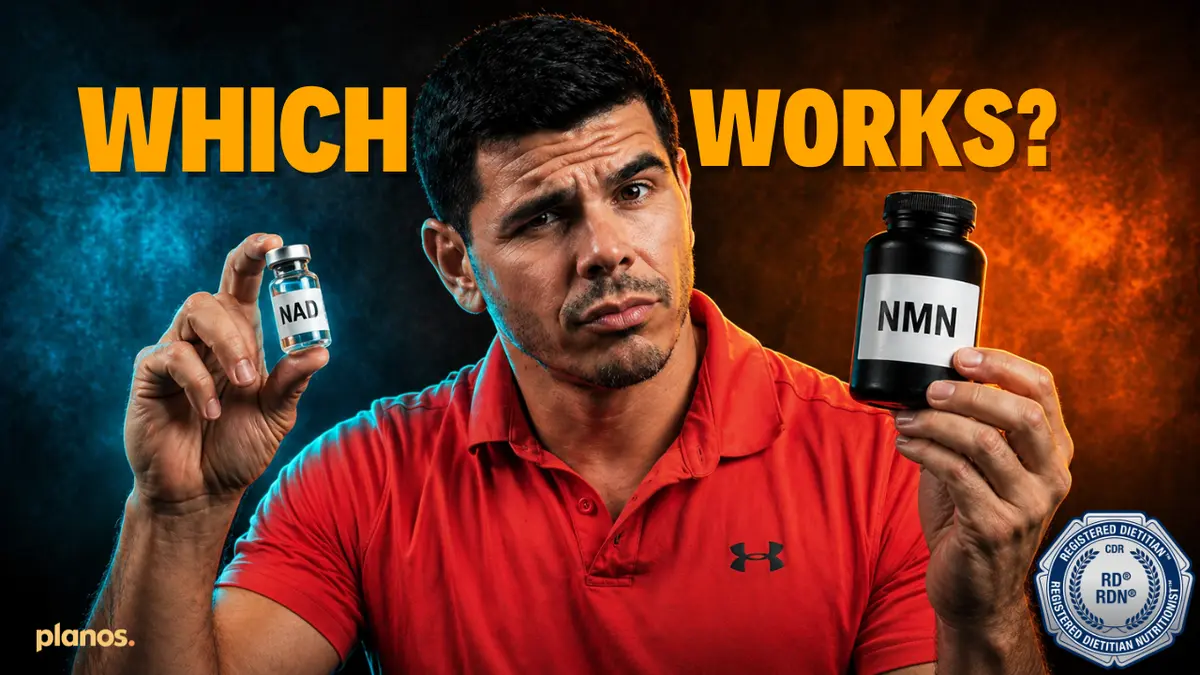
Longevity Clinics Will Tell You NAD Injections Are the Most Powerful Anti-Aging Tool Available. Here's What the Research Actually Says.
Subcutaneous NAD injections run about $300 a month. IV drip sessions at longevity clinics can hit $500 to $1,000 per visit. The pitch is that this is direct cellular refueling, the most effective way to restore the molecule your body needs for energy production, DNA repair, and aging well.
Some of that pitch is grounded in real biology. Some of it is marketing that the research doesn't yet support. After almost a year of doing NAD injections myself and reviewing the latest 2026 literature on both delivery methods, here's an honest breakdown of what injections actually do, who they make sense for, and who is almost certainly wasting their money.
What NAD Is and Why It Matters
NAD stands for nicotinamide adenine dinucleotide. It's a coenzyme your body requires for energy production, DNA repair, and cellular signaling. NAD levels decline with age. That part is well documented in the research and not seriously disputed.
The question is not whether NAD matters. It's whether spending hundreds of dollars per month on injections is the most effective way to address declining levels, and whether the benefits being marketed at longevity clinics have the evidence behind them to justify the price.
Why Injections Are Biologically Different From Supplements
You cannot absorb NAD directly through your gut. Your digestive system breaks it down before it reaches your bloodstream. That's why oral supplements use precursors like NMN (nicotinamide mononucleotide) and NR (nicotinamide riboside), compounds your body can absorb and then convert into NAD.
Here's where it gets complicated. A major 2026 study published in Nature Metabolism found that NR and NMN may not even be absorbed intact the way most people assume. A significant portion of the conversion to NAD appears to happen through gut bacteria. Your microbiome breaks the precursors down into nicotinic acid, essentially niacin, and your body then rebuilds it into NAD from there.
What that means in practice: two people taking the exact same NMN supplement can get completely different results depending on their gut microbiome composition. That variability is rarely discussed in the supplement marketing you're seeing on social media.
Injections bypass this entirely. Subcutaneous or IV delivery puts NAD or its precursors directly into circulation, skipping both the digestive breakdown and the microbiome variable. The same dose injected produces a measurably higher blood NAD response than the same dose swallowed. That part is pharmacologically documented and real.
There are three main injection types: IV infusions administered in clinics, subcutaneous injections given under the skin that can be self-administered at home, and less common options like nasal spray or intramuscular delivery.
What the 2026 Research Actually Found
Here's the part longevity clinics are not putting in their marketing materials.
A 2026 PRISMA-guided systematic review, which is the gold standard methodology for reviewing all available research on a topic, looked at every published human trial on NAD injections for anti-aging and wellness outcomes. The conclusion on IV NAD injections specifically: zero eligible outcome trials. Not a single published study has tested whether IV NAD produces measurable anti-aging results in humans. The existing data consists of biomarker changes and tolerability reports, nothing more.
What the evidence does support: injections produce faster and more significant increases in blood NAD levels compared to oral supplements. There is some clinical data suggesting potential benefits for people with metabolic dysfunction, chronic fatigue, and certain neurological conditions. IV NAD has a reasonably strong track record in addiction recovery settings for reducing withdrawal symptoms. In populations with documented clinical NAD deficiency, older adults, people recovering from serious illness, and people with mitochondrial dysfunction, the injection route has a stronger case.
Where the evidence doesn't support the price tag: there are no large-scale randomized controlled trials in healthy adults showing that NAD injections outperform well-dosed oral precursors for real-world health outcomes.
A 2019 IV NAD pilot study tracked what happens during a six-hour infusion and found that NAD gets rapidly broken down in the blood into other compounds anyway. The marketing image of direct cellular refueling is an oversimplification of what's actually happening biochemically.
One more finding worth knowing: a 2026 retrospective comparison of IV NAD and IV NR found that every single IV NAD client reported moderate to severe infusion symptoms including GI cramps, nausea, chest pressure, and increased heart rate. IV NR was significantly better tolerated. That matters when you're choosing between delivery formats at a clinic.
The Cancer Question Nobody Is Talking About
This section matters and almost no one in the wellness space addresses it directly.
NAD is a currency molecule. Your healthy cells use it, and so do tumor cells. The research on NAD and cancer is genuinely mixed and context-dependent.
A 2023 study found that NR supplementation was linked to increased brain metastasis in a triple-negative breast cancer mouse model. A different 2023 study found that NMN supplementation suppressed metastasis in a different breast cancer model through a completely different mechanism. Same molecule family, opposite results in two different cancer contexts.
The bottom line for anyone with a cancer history, active treatment, or even just a family history worth paying attention to: there is no strong clinical evidence that NAD injections treat cancer. There is a plausible interaction risk with certain chemotherapy drugs. One active clinical trial for NR is specifically monitoring drug levels in patients receiving paclitaxel because NR may alter how the chemotherapy works in the body.
If you are in active cancer treatment, do not self-direct NAD supplementation. This is a medical conversation with your oncologist, not a supplement decision.
Who Should Consider Injections and Who Shouldn't
Three groups where injections may be worth a real conversation with a physician:
Adults 50 and older with documented metabolic decline. Blood NAD levels typically drop with age, and the delivery advantage of injections matters more in this population. If you have bloodwork showing decline and you're working with a doctor, the conversation is reasonable.
People in addiction recovery. IV NAD has the strongest clinical case in this population. The existing data on withdrawal symptom reduction and brain function support is more credible here than in any other use case.
People with chronic fatigue or mitochondrial conditions. Some clinical evidence exists, but this should always be pursued under medical supervision.
Two groups where injections are almost certainly not worth the cost:
Healthy adults under 45. If you're sleeping seven to eight hours consistently, training with resistance work, eating enough protein, and managing stress reasonably well, you're already doing more for your mitochondria than a $500 injection will add. The evidence for injections over solid foundational habits in this population is genuinely weak.
Anyone using injections as a substitute for foundational habits. Spending a thousand dollars a month on peptides and NAD while eating processed food at every meal is not a longevity strategy. It's an expensive supplement cabinet.
Before spending $300 on an injection, consider what your protein intake actually looks like. Tryptophan and niacin, found in lean beef, chicken, turkey, fish, peanuts, and avocado, are direct precursors to NAD. Most people haven't optimized that baseline. Resistance training is also one of the most evidence-backed ways to upregulate NAD naturally. Both of those cost significantly less than a longevity clinic visit.
One More Problem: Supplement Quality
If you decide the oral supplement route makes more sense for your situation, supplement quality is a real issue worth taking seriously.
A 2024 study tested popular NMN supplements against their label claims. Deviations ranged from 28% overdose to 100% underdose, meaning some products contained literally zero active ingredient. The supplement industry is not regulated the way pharmaceuticals are. Third-party testing is the only reliable way to verify you're getting what the label says.
My Personal Experience After Almost a Year of NAD Injections
I've been doing subcutaneous NAD injections for close to a year. Here's an honest account of what I noticed and what I didn't.
After each injection, I do notice what feels like an increase in energy and a mild tingling sensation, mostly in my legs, that fades over time. I seem to feel somewhat less fatigued overall. Whether any of that is the NAD or the placebo effect of doing something intentional for your health, I genuinely can't say with certainty.
What I can say is that it hasn't been life-changing. Some people report dramatic improvements. My experience has been subtle at best. When my current supply runs out, I'm not planning to renew it, because I don't think it's making a meaningful enough difference to justify the ongoing cost at my age and health status.
I'm sharing this not to sell you on NAD or talk you out of it. I'm sharing it because the wellness space needs more people who actually use these things, read the research behind them, and give you an honest account of both.
The Bottom Line
NAD injections are not a scam. The delivery mechanism is real and biologically superior to oral supplements for getting NAD into your bloodstream. But the marketing that equates higher blood NAD levels with meaningful anti-aging outcomes in healthy people is running well ahead of the evidence.
The injection beats the pill on delivery. Neither one beats the basics. Sleep, protein, resistance training, and stress management have 50 years of evidence behind them. NAD injections, particularly for healthy adults, do not.
If you're over 50 with documented metabolic decline or working through recovery, talk to your doctor about whether injections are appropriate for your situation. If you're a healthy adult in your 30s or 40s looking for a longevity edge, invest in the foundation first. The advanced chapter doesn't work if you haven't read chapter one.
This article is for informational purposes only and does not constitute medical advice. Consult your physician before beginning any injection protocol or new supplement regimen.