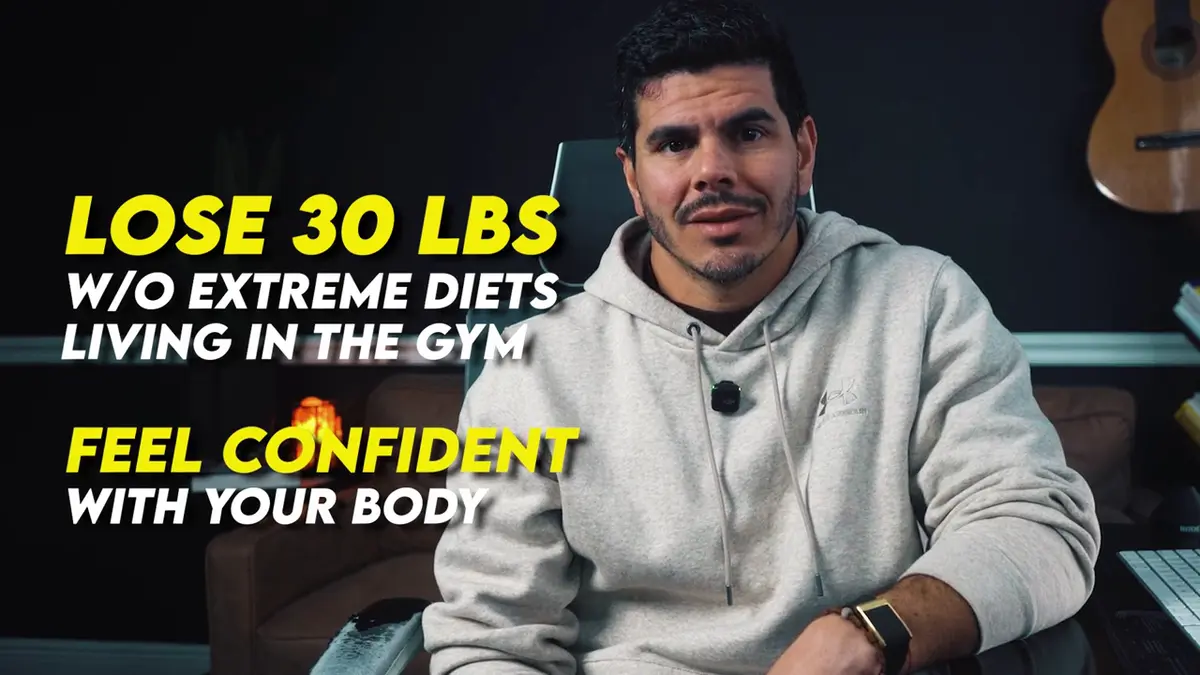
Most men in their 30s and 40s who can't lose weight are working hard. Cutting calories, hitting the gym five or six days a week, eating clean, grinding through the week on willpower. And ending up back at square one every few months.
That's not a discipline problem. That's a system problem.
As a registered dietitian who has worked with hundreds of clients, including professional athletes across the NFL, NBA, MLB, and NHL, and executives running multimillion-dollar companies, I've seen this play out more times than I can count. Here's what actually breaks the cycle.
Why Eating Less and Training Harder Keeps Failing You
The conventional advice is simple: create a calorie deficit, push harder, stay disciplined. And discipline matters. But treating it as your primary strategy leads to three predictable outcomes.
You burn out. Willpower is finite, and the moment life gets stressful, the plan collapses. You lose muscle alongside fat, because undereating combined with overtraining breaks down tissue your body needs. And the weight comes back, not because you failed, but because the approach was never built to hold up under real conditions.
James Clear put it plainly in Atomic Habits: you don't rise to the level of your goals, you fall to the level of your systems. That's not inspiration. That's a description of how behavior actually works.
The Client Who Was Doing Everything Right and Still Stuck
I worked with a client, Mike, who came to me eating around 1,800 calories a day and training five to six times a week. He was 225 pounds and had been stuck there for years, doing exactly what the internet told him to do. He wasn't missing information. He was missing structure.
We didn't cut his calories further. We built a system around four things:
A clear nutrition framework so he wasn't making food decisions from scratch every day
A structured strength-focused training plan with a specific process to follow, not just cardio and guesswork
Objective weekly tracking with adjustments based on actual data, not how he felt
A shift away from emotional food decisions, which also improved his relationship with food over time
He didn't try harder. He stopped guessing. In four months, he dropped 30 pounds and increased his calories to over 2,500 a day. His words: "In four months I accomplished more than I couldn't accomplish in the past four years."
Why Systems Beat Willpower Every Time
Think about how you run your career or your business. You don't generate more revenue by wanting it harder. You build tracking systems, create processes, and make decisions with data. You install feedback loops so you know what's working.
With your body, most people do the opposite. They restrict when things get serious, rely on motivation to stay consistent, and abandon the plan when life gets in the way. Then they start over.
Every behavioral change model shows the same thing: when outcomes depend on willpower alone, results decay over time. When outcomes depend on systems plus feedback, consistency increases and stress decreases. This is why elite athletes follow protocols. Why pilots use instruments. Why businesses track numbers. Your health is not the exception.
What Consistent Fat Loss Actually Requires
Another client, TJ, had been at this for years on his own. He wasn't lazy or uninformed. He was consuming good content and running in circles because he had no feedback mechanism to tell him what to fix. Two months of working together produced results he hadn't hit in two years on his own.
The difference wasn't new information. It was a personalized structure with accountability built in, so the right behaviors became easier and more automatic.
Both Mike and TJ made the same mental shift. They stopped asking "how do I try harder?" and started asking "what do I need to build so I don't have to try as hard?"
Consistency doesn't come from pushing through forever. It comes from no longer needing to push as hard, because the right structure is doing the heavy lifting.
How to Apply This Starting This Week
If you've been stuck despite doing what you're supposed to be doing, the problem almost certainly isn't effort. Start by auditing what you're actually tracking. If the answer is nothing, or nothing systematic, that's the gap.
A few places to start:
Set a protein target based on your bodyweight. For most men trying to lose fat and retain muscle, 0.7 to 1 gram per pound of bodyweight is a solid baseline.
Shift your training toward strength work with progressive overload, rather than defaulting to cardio as your primary fat loss tool.
Track your intake for at least two weeks before making changes. Most people are surprised by the gap between what they think they eat and what they actually eat.
Build weekly review points into your routine so you can make small, data-informed adjustments instead of reacting to how you feel.
None of this is complicated. The hard part is doing it consistently. That's where structure beats motivation every time.
The Bottom Line
Losing 30 pounds without burning out is not about finding more discipline. It's about building a structure that makes discipline less necessary. When the right systems are in place, results become predictable instead of random. That's how the clients I've worked with for nearly 13 years actually get the weight off and keep it off.
Ready to stop guessing? I offer a one-on-one assessment call for men who want a personalized plan with structure, tracking, and accountability built in. Applications are open and the link is in the description. If you're not there yet, keep reading here and I'll keep breaking down exactly how to build these systems.